 Ars
Technica reports
Ars
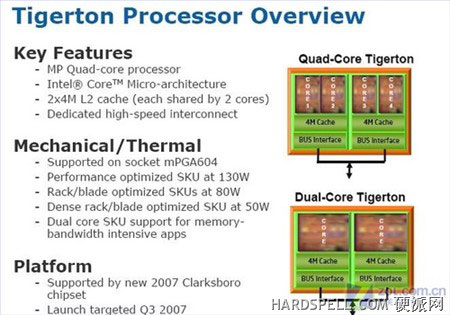
Technica reports that Intel launches Tigerton quad-core Xeons and Caneland
server platform. The new platform supports up to four of Intel's new quad-core
Xeons for 16-way multiprocessing. These Xeons replace the previous generation of
Netburst-based Xeons, and if the SPEC benches that are already up are any
indication, Intel PR's claims that the new Xeons double the performance of the
previous Xeons are true. There's no question that Tigerton is speedy, and
it looks to be the case that on CPU-bound workloads its performance is very
solid. What's less clear is the degree to which the new Caneland platform's
system architecture is holding this new processor back.
Caneland's biggest feature is that its four processor sockets are connected
to the memory controller hub (MCH) by four 1066MHz frontside buses. Now four
FSBs that fast make for a ton of bandwidth, but as the Inquirer pointed out back
in 2005 when news of Caneland first trickled out, a four-FSB system architecture
was a hot new idea in 1999 with the Alpha EV6. In today's world of
HyperTransport and NUMA, this four-FSB architecture is basically a stop-gap hack
to bide time until CSI can make it to market late next year.
Intel announced the six-member 7300 series of quad-core Xeons at frequencies of 1.86GHz (for the blade-optimized parts) to 2.93GHz. The lower-end blade parts have TDPs of 55W, while the high-end 2.93GHz part has a TDP of 130W. The processors in the middle of the pack have TDPs of 80W. According to
InfoWorld,
the new quad-core Tigerton will go for $856 to $2,301 per processor in lots
of a thousand.



)