 Intel
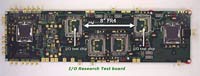
said that it has developed a new I/O technology
Intel
said that it has developed a new I/O technology, which only consumes about
14% of the power of PCI Express 2.0. At a maximum data rate of 5 Gb/s, PCI
Express 2.0 consumes about 20 mWatts per Gb/s bandwidth. Intel claims that its
new and not yet named technology can achieve 5 Gb/s at about 2.7 mWatts per
Gb/s. So far, the power efficiency of the technology is scaling almost linearly
and achieved 3.6 mWatts per GB/s at 10 Gb/s and 5.0 mWatts per Gb/s at 15 Gb/s -
which, to our knowledge, is the best power efficiency result for I/O receivers
achieved so far. Infineon claimed the crown in this category in February 2006,
when it disclosed details about a 9.6 Gb/s transceiver running at 10.4 mWatts
per Gb/s. At least in theory, Intel's interface could bump the available
bandwidth of today's available bandwidth by a factor of 3 while consuming 75%
less power.
Randy Mooney, a Fellow and director of I/O research at Intel, however,
pointed out that the technology is still at a research stage. He confirmed
that we could see the technology surfacing within a few years in Intel products,
but declined to comment on specific products. Instead, Rooney explained that the
new I/O findings will be a key technology in enabling 'a large number' of cores
(which means more than 10 cores, according to company representatives). Example
applications could include point-to-point links in microprocessors, which will
replace the front side bus in today's Intel architecture.



)